AUTOart 1:18 Honda RA272 F1 Grand Prix Mexico 1965 (Richie Ginther) - Review
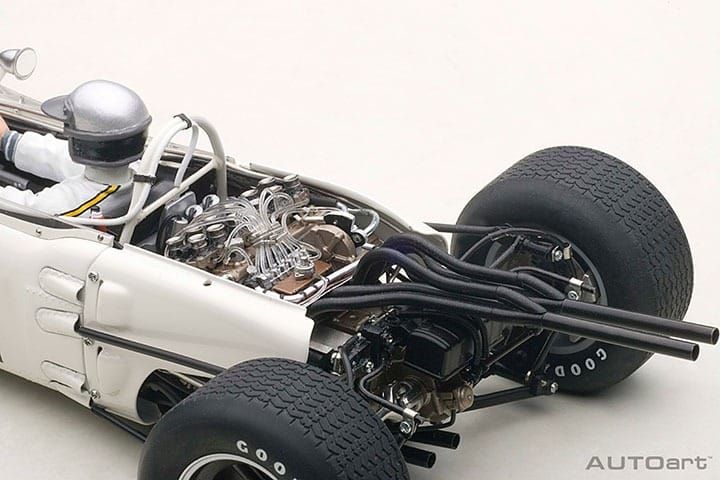

AUTOart’s 86599 Honda RA272 is a 1:18‑scale recreation of the white #11 car that Richie Ginther drove to Honda’s first Formula 1 victory at the 1965 Mexican Grand Prix. Limited to 2 000 pieces, the model replicates the RA272’s compact transverse‑mounted V12, delicate open chassis and race‑winning details remarkably well. Below is an honest, balanced look at where this model shines and where it falls a bit short.
Paint & Bodywork – 9/10
The first impression is excellent. AUTOart’s smooth white paint application looks period‑correct and consistent across all panels, and delicate rivets along the aluminum body are replicated convincingly. Panel gaps are tight, the nose cone fits properly and the slender rear bodywork looks crisp once it’s attached. Because the RA272’s bodywork was hand‑formed on the real car, the slight asymmetry captured in the model feels authentic. The pre‑applied racing livery is crisp and period‑appropriate. One minor drawback is that some pieces, such as the rear body section and nose, must be screwed into place; this keeps the model rigid but requires careful assembly to avoid marring the paint.

Interior & Cockpit – 8/10
The small cockpit is highly detailed. AUTOart includes a driver figure wearing period‑correct goggles and helmet, which is removable if you prefer an empty seat. Once the rear body panel is off, you can appreciate the bucket seat, harnesses and pedals. The dashboard features individual gauges, toggle switches and warning labels, and the tiny shifter and exposed cables mimic the real RA272’s spartan cockpit. There are even small tubes and wiring running along the sides. However, because of the model’s size and the tubular chassis, it can be difficult to see some of these details without removing the bodywork. Flocking on the floor and more realistic seatbelt material would have further elevated the cockpit.

Engine & Mechanical Detail – 9/10
This is where the RA272 really earns its keep. Removing the rear section reveals a beautifully reproduced 1.5‑litre transverse V12 engine with individual fuel lines, linkages and ancillaries. The delicate suspension arms actually flex; the front suspension compresses and the rear axles spin freely. The exhaust system is finely molded with realistic heat shielding. Even tiny springs and clamps are present around the intake trumpets. This level of mechanical depth rewards owners who like to display the car with panels off. The only compromise is that the model uses screws to secure some components; while this is structurally necessary, it breaks the illusion when viewing the car from below.

Ease of Assembly & Display – 7/10
Unlike sealed die‑casts, this model arrives partly disassembled. You must attach the front nose cone, rear body cover and sometimes the undertray using small screws and tiny brake lines. Instructions are provided, but the process requires patience and a steady hand. Once together, the model is sturdy and the wheels roll freely, but the assembly step may frustrate collectors used to display‑ready models. The inclusion of a driver figure is a nice touch, though it limits how easily you can see the cockpit without removing him.

Overall Value – 9/10
At roughly $400–$500 USD when new, the RA272 is expensive, but it’s also a limited‑edition model made up of around 529 individual parts. The weight of the finished model feels reassuringly substantial for its size, and the finished product looks unlike any other F1 car thanks to the RA272’s unique engine layout. Collectors who appreciate fine mechanical detailing will find plenty to admire, from the flexing suspension to the tangle of fuel lines. Those looking for a simple out‑of‑the‑box display piece may find the assembly and delicate details less appealing. Ultimately, AUTOart’s RA272 captures an important piece of racing history with impressive attention to detail and is well worth adding to a collection if you enjoy interacting with your models.

Final Score – 8.4/10
The AUTOart 86599 Honda RA272 is a standout in the Signature series. Its combination of excellent paint and bodywork, rich mechanical detail and limited‑edition exclusivity makes it one of the better classic F1 replicas available. Minor drawbacks like the need for assembly and some simplistic cockpit finishes prevent a perfect score, but overall it’s a model that earns pride of place on a shelf.